Flow control of single quantum dot enables low-cost, nanoscale imaging

02/13/2013

University of Maryland (UMD; College Park, MD) researchers have developed a novel technique for imaging far below the diffraction limit (below 400 nm) by using a particle that is much smaller than the wavelength of light as an optical probe. Called a quantum dot, the particle is manipulated with high precision using an inexpensive microfluidic device, enabling the researchers to capture nanoscale measurements with 12 nm spatial accuracy.

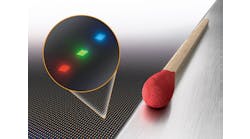
A quantum dot is a 3–6 nm-sized, semiconducting particle about 25 times the diameter of a single atom. At room temperature, quantum dots can emit single photons of light that can be tuned to a desired wavelength. This makes them ideal probes for examining nanostructures smaller than the visible light threshold. Positioned close to a nanoscale object, the quantum dot becomes a sort of spotlight that amplifies what the microscope alone cannot see.

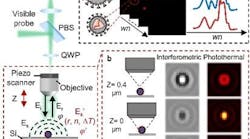
The research team's solution lies in a microfluidic device that manipulates and positions quantum dots using precision flow control. A computer algorithm analyzes the dots dispersed inside, selecting one to be the reporting probe. As the microfluidic device creates a fluid flow, the targeted dot begins to move. An image-guided feedback process continually tracks the dot's location and adjusts the flow accordingly. For example, if the dot is observed to be to the northwest of its desired location, a southeast flow is created to move it into place.

This technique gives researchers the ability to manipulate a single dot precisely, guiding it quickly to desired locations, and holding it in each position with nanometer accuracy so it can be used to scan objects. The dot's response to each scanned object is measured, providing information about the object's electromagnetic fields with nanoscale resolution. Since nothing mechanical touches the quantum dot or affects its interaction with the objects it scans, the images produced are distortion-free, clean and sharp.

"In other particle manipulation techniques—for example laser tweezers—the force applied to a particle scales with its volume," explains Clark School of Engineering Prof. Benjamin Shapiro, Fischell Department of Bioengineering and the Institute for Systems Research, one of the paper's co-authors. "But the viscous forces that the fluid flow applies scale with the diameter of the particle. At the nanoscale, fluid flow has a greater effect on the particle than competing techniques, allowing us to move, guide and immobilize the quantum dot more easily and accurately."

In addition to its technical superiority, the new nanoscale manipulation system is far less expensive than near-field scanning optical microscopy, which requires equipment that costs hundreds of thousands of dollars.

"The new technique is more versatile, easier to implement, and more accurate by an order of magnitude than conventional near-field scanning optical microscopy," says Shapiro's colleague, Prof. Edo Waks (Department of Electrical and Computer Engineering and Institute for Research in Electronics and Applied Physics). "Basically, we can take a microscope, add a disposable microfluidic device, and beat the capabilities of an NSOM at a fraction of the cost and complexity.

"An undergraduate could build the basic two-channel microfluidic device used in the process, using standard soft-fabrication techniques, in less than an hour for under $50," he adds.

The UMD team is hoping to package all of the necessary system components into an inexpensive add-on product for microscopes.

For more information on the work, which has been published in Nature Communications, please visit http://www.nature.com/ncomms/journal/v4/n2/abs/ncomms2477.html.

-----

Follow us on Twitter, 'like' us on Facebook, and join our group on LinkedIn

Subscribe now to BioOptics World magazine; it's free!

Font Sizes:

BioOptics World Magazine

Most Popular Article


Is Your Research Cover Worthy?

Enter your light microscopy photo for a chance to appear on the Edmund Optics Catalog!

We’re looking for the best-of-the-best natural, environmental or cellular structures found in Light Microscopy to enter Edmund Optics’ Micro Marvels photo contest. 5 Finalists will be selected with the grand prize winning photo to appear on an Edmund Optics Fall 2013 catalog.

Hurry, Enter by March 31, 2013!

Sponsored by:

BioOptics Blogs

Optical data analysis looks to clinical applications

Thu Feb 21 15:35:00 CST 2013 - BioOptics StudentView Blog

Swanson inspires with OCT review at Laser Marketplace Seminar

Mon Feb 04 16:58:00 CST 2013 - BioOptics Worldview Blog

On-chip technologies shine light on human sperms

Tue Jan 29 16:32:00 CST 2013 - BioOptics StudentView Blog

Cell Bio 2012 event brims with biophotonics innovations

Wed Dec 26 14:20:00 CST 2012 - BioOptics Worldview Blog

BioOptics World Archives

View BioOptics World past articles.